
$100 Oil and the AI Gold Rush: 5 Surprising Truths About the Markets in March 2026
1. Introduction: When Geopolitics Meets Innovation
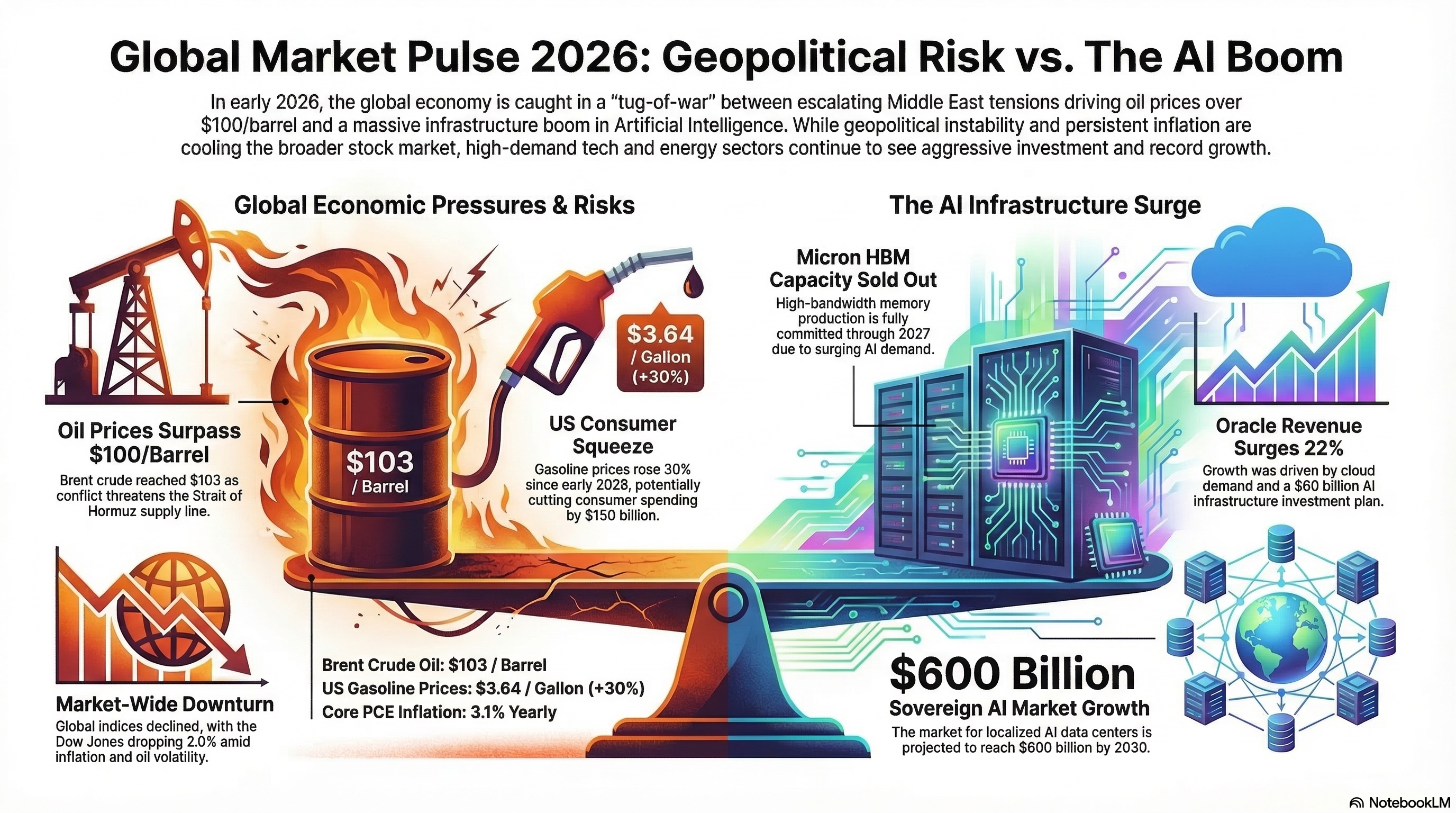
As Brent crude oil brushes the $103 mark, savvy investors in March 2026 aren't looking in the rearview mirror; they are focused on 2027 capacity plans. The current market situation resembles a digital tightrope walk:
- Energy Shocks: Imminent threats of massive supply disruptions due to escalations in the Middle East.
- AI Hype: Unchecked momentum in the semiconductor sector driving valuations to dizzying heights.
It is a modern paradox—the "Old World" of fossil fuels and the "New Era" of Artificial Intelligence are colliding with a force that is pulverizing traditional trading strategies.
2. The $150 Billion Shock: Why Gas Prices Are More Than Just a Number
At the pump, prices have become the seismograph of the US economy this spring. Since the beginning of the year, US gasoline prices have surged nearly 30%, reaching an average of $3.64 per gallon.
"The conflict with Iran could trigger a potentially horrific global economic shock," warns economist Paul Krugman, citing the precarious supply situation.
Market Impact:
- A mere $20 increase per barrel of oil has the potential to slash US consumer spending by $150 billion annually.
- Contrarian Opportunity: Companies like AutoZone become "safe harbors." When budgets for new cars are eaten up by energy costs, consumers pivot to maintaining their current vehicles.
3. Sold Out Until 2027: The Real Bottleneck of the AI Revolution
Behind the "AI Gold Rush" lies a hard physical reality in March 2026: we simply do not have enough memory. Data from Micron Technology is clear—High-Bandwidth Memory (HBM) capacity is fully booked well into 2027. DRAM prices are expected to rise by an astronomical 171% by the end of 2026.
The Three Main Beneficiaries:
| Company | Strategic Role | Key Metric / Target |
|---|---|---|
| Nvidia | The Unrivaled Epicenter | 36,000 B200 chips for ByteDance alone |
| Micron | Memory Gatekeeper | Benefiting from 171% DRAM price hikes |
| Oracle | Infrastructure Powerhouse | $90B revenue guidance for FY 2027 |
4. The Strait of Hormuz Paradox: Trump’s Calm vs. Market Fear
Geopolitics is currently locked in a bizarre duel with market psychology. While Paul Krugman warns of $150 oil should Iran block the Strait of Hormuz, President Trump remains demonstratively calm, focusing primarily on the Iranian nuclear program.
The "Fear Trade": Markets are betting on a "hidden lever"—a globally coordinated release of 400 million barrels from Strategic Petroleum Reserves (SPR). Meanwhile, Commodity Trading Advisors (CTAs) are exhibiting rare behavior: they are piling into the US Dollar and Oil simultaneously while dumping Treasury bonds. Typically, a strong dollar and high oil prices are negatively correlated; in March 2026, they are rising in tandem as a defensive play.
5. Apple’s China Retreat? Silent Concessions in the East
Apple is fighting with its back against the wall in the Far East. A 37% drop in iPhone shipments in China has forced Cupertino into once-unthinkable tactical concessions to counter regulatory pressure and competition from Tencent:
- App Store Fees: Slashed from 30% to 25% (and 12% for mini-apps).
- Impact: This saves Chinese developers over $873 million annually but pressures Apple’s margins.
- The "India Pivot": To compensate, Apple increased production in India by 53% in 2025, radically restructuring its global dependencies away from the Chinese geopolitical powder keg.
6. The End of the Hedging Era: A Lesson from Southwest Airlines
In volatile markets, risk management is a necessity for survival. Southwest Airlines serves as a warning in March 2026: their stock price plummeted immediately following the expiration of their fuel-hedging program. While competitors like Delta and United struggle with billion-dollar fuel surcharges, Southwest’s unhedged balance sheet is taking the full force of $100 oil.
7. Conclusion: The Road Ahead
The market in March 2026 is a battlefield between macroeconomic gravity and technological escape velocity. The energy crisis acts as a deflationary anchor on consumption, while the AI industry orbits in its own highly profitable atmosphere.
The ultimate question for investors: Will AI's innovative power be enough to outweigh the recessionary forces of a global energy shock? The answer will determine if we are at the dawn of a new Industrial Renaissance or facing a resource-induced downturn.
Not investment advice. Independently verify information and assumptions.